

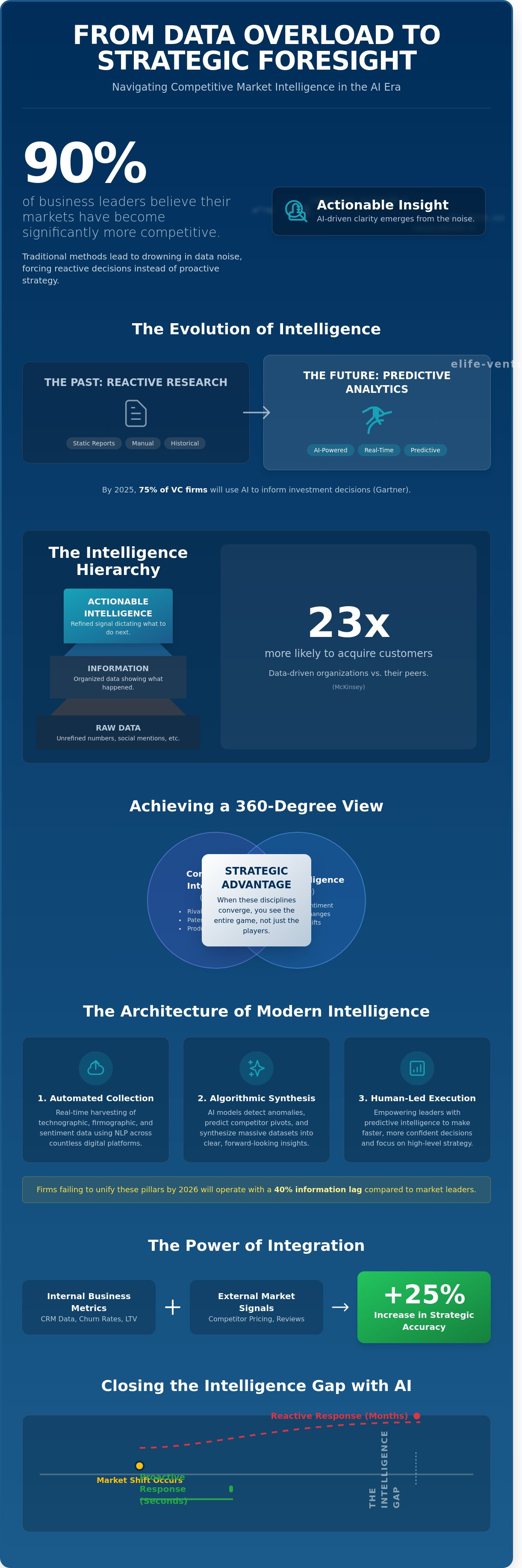
A 2024 industry report by Crayon reveals that 90% of business leaders believe their markets have become significantly more competitive over the last twelve months. You likely feel this pressure every day as data sources multiply and competitive market intelligence feels more like a burden than a benefit. It's difficult to move beyond reactive decision-making when your team is drowning in noise rather than insights. We know it's frustrating when AI feels like an added complexity rather than a strategic shortcut.
We're here to change that narrative. This guide empowers you to transform raw industry data into predictive strategic assets. We'll show you how to align AI-driven tools with your long-term mission to drive sustainable growth. You'll discover a clear framework for intelligence gathering, learn how to generate insights that actually predict the future, and ensure your technology stack serves your human potential. Let's pioneer a new standard for strategic advantage together.
Key Takeaways
- Evolve from reactive research to AI-powered predictive analytics to synthesize competitor moves into visionary foresight.
- Integrate internal business metrics with external signals to build a modern intelligence architecture that powers decisive action.
- Scale your innovation by balancing short-term tactical wins with the long-term sustainability of strategic planning.
- Deploy a five-step framework for competitive market intelligence to define core objectives and audit high-impact data sources.
- Bridge the gap between emerging AI innovation and operational reality through a collaborative approach to intelligent transformation.
What is Competitive Market Intelligence in the AI Era?
Competitive market intelligence is the strategic synthesis of rival movements and industrial shifts. It's the nervous system of a modern enterprise. By 2026, static research is a liability. We view intelligence as the catalyst for digital transformation. It empowers leaders to move from reactive defense to proactive disruption. This process isn't about collecting files; it's about engineering a vision for the future.
The transition from manual research to AI-powered predictive analytics is absolute. A 2023 Gartner report projected that 75% of venture capital firms would use AI to inform investment decisions by 2025. This shift replaces quarterly reports with live, algorithmic insights. We recognize that the foundation of any digital pivot is the ability to anticipate change before it arrives. It's the difference between following a trend and setting the pace.
Distinguishing between data, information, and intelligence is vital for strategic clarity.
- Raw Data: The unrefined numbers and social mentions that flood your systems daily.
- Information: Data that's organized and filtered to show what happened in the past.
- Actionable Intelligence: The refined signal that dictates capital allocation and product roadmaps.
Market Intelligence vs. Competitive Intelligence
Market intelligence focuses on the macro environment. It tracks consumer sentiment shifts and regulatory changes that affect the entire ecosystem. Competitive intelligence zooms in. It deconstructs a rival's specific pricing strategy or their latest patent filing. We believe a 360-degree view requires both. When these disciplines converge, you see the entire board. You don't just see the players; you see the game.
The Role of AI in Modern Data Synthesis
AI transforms static reports into real-time data streams. It detects anomalies in massive datasets that human analysts often miss. These tools allow us to identify emerging competitors before they reach significant scale. We use these technologies to bridge the Intelligence Gap. The Intelligence Gap is the time between a market shift and a business response. By 2026, successful firms will measure this gap in seconds, not months. AI accelerates our ability to sense, think, and respond. It keeps us connected to the human element of the digital space by freeing leaders to focus on high-level strategy rather than manual sorting.
The Architecture of Modern Intelligence: Data, AI, and Strategy
Visionary intelligence relies on a tripod of core capabilities. We define these as automated collection, algorithmic synthesis, and human-led execution. By 2026, firms that fail to unify these pillars will operate with a 40% information lag compared to market leaders. This architecture demands a culture where data dictates direction. It's about moving beyond gut feelings to embrace calculated precision. We prioritize the human element to ensure that technology serves the strategy, not the other way around.
Effective competitive market intelligence requires blending internal business metrics with external market signals. Many founders ignore their own churn data while obsessing over a rival's press releases. True advantage emerges when you map internal customer lifetime value (LTV) against external market shifts. We see a 25% increase in strategic accuracy when teams integrate CRM data with real-time competitor pricing feeds. This integration creates a feedback loop that informs every department, from product development to sales. It ensures the entire organization moves in sync with the market.
The focus has shifted from "what happened" to "what will happen next." Historical data is a mirror; predictive intelligence is a window. By analyzing patterns in patent filings or job postings, we can anticipate a competitor's pivot six months before it occurs. This foresight allows for a proactive stance. It transforms the business from a reactive entity into a market shaper. Decisive action is the only way to maintain this lead.
Data Harvesting and Automation
Manual tracking is a relic of the past. Modern stacks automate the collection of technographic and firmographic data in real-time. We use Natural Language Processing (NLP) to parse sentiment from competitor reviews across 50+ digital platforms. This transforms qualitative feedback into quantitative signals. High-quality, clean data is the foundation. Without it, your AI models will produce flawed projections. We prioritize accuracy over volume to ensure every insight is actionable and reliable.
Strategic Analysis Frameworks
Static models are obsolete in a high-velocity environment. We utilize modern variations of the How to Do a SWOT Analysis: A Visionary Guide to Strategic Planning to identify digital-era vulnerabilities. Scenario planning allows us to model three to five distinct future outcomes based on current competitive market intelligence. This shift defines the 2026 mindset. It moves your team from reactive defense to proactive disruption. We help you build these resilient systems to ensure your growth remains steady regardless of market volatility.
Tactical vs. Strategic Intelligence: Navigating Short-term Wins and Long-term Vision
Competitive market intelligence isn't a monolith. It operates on two distinct timelines that must function in harmony. We see many firms over-index on the immediate, losing sight of the horizon. A balanced approach ensures that your current wins fund your future dominance. We view this duality as the difference between surviving the quarter and owning the decade.
Tactical Intelligence: Winning the Day
Tactical intelligence focuses on the immediate environment. It's about maintaining a 24-hour pulse on the market to protect your current position. We use these insights to empower sales teams and defend margins against sudden shifts. This data is often perishable but carries high immediate value.
- Pricing and Promotions: Monitoring rival pricing shifts is vital. In high-velocity SaaS sectors, pricing adjustments now occur up to 4 times per year.
- Feature Gap Analysis: Identifying a rival's missing integration allows for targeted marketing strikes.
- Sales Battle Cards: Equipping teams with real-time rebuttals increases win rates by an average of 15% according to 2023 industry benchmarks.
Strategic Intelligence: Winning the Decade
Strategic intelligence looks beyond the next quarter. It identifies technological disruptions that might render current products obsolete by 2026. This data informs high-stakes decisions like M&A activity and international expansion. A 2024 McKinsey study found that 60% of successful market entries were preceded by at least 18 months of deep intelligence gathering. To thrive, you must integrate these long-term insights into your AI Business Strategy: The 2026 Framework for Scalable Innovation.
The Ethical Boundary: Intelligence vs. Espionage
We often address the objection: Is gathering data on rivals ethical? The answer lies in the source. Ethical competitive market intelligence relies on synthesis, not theft. It transforms raw, public data into a visionary roadmap. We strictly follow the SCIP (Strategic and Competitive Intelligence Professionals) Code of Ethics, which prohibits misrepresentation or illegal intrusion.
Establishing legal boundaries is essential for strategic trust. We focus on three core pillars of data collection:
- Public Disclosures: Analyzing SEC filings, patent applications, and annual reports.
- Digital Footprints: Monitoring open-source signals, job postings, and technographic data.
- Aggregated Sentiment: Utilizing 2025 AI tools to scrape consumer reviews and forum discussions.
Legality is non-negotiable. By focusing on transparency, we protect the brand's reputation while gaining a decisive edge. We don't just collect data; we build a foundation for sustainable innovation that respects the human element of the digital space.
Building a Future-Proof Intelligence Framework: A 5-Step Guide
Strategy without structure is just hope. We build frameworks that turn market noise into actionable signals. A robust competitive market intelligence system relies on five pillars designed for the speed of 2026.
- Step 1: Define core objectives and Key Intelligence Questions (KIQs). Start with the end in mind. Precision beats volume.
- Step 2: Identify and audit multi-channel data sources. Scour diverse streams. Gartner reports that 80% of enterprise data is unstructured. Scour dark social, regulatory filings, and patent databases.
- Step 3: Deploy AI automation for continuous monitoring. Speed is the new currency. Use Large Language Models to track shifts in real-time.
- Step 4: Synthesize insights through cross-functional collaboration. Intelligence dies in silos. Bring product, sales, and finance together to provide context.
- Step 5: Execute and optimize based on iterative feedback. Move fast. Adjust. The market tells you if your thesis is correct.
Setting Your Key Intelligence Questions
Focus on the "why" behind competitor moves. If a rival acquires a boutique AI firm on August 15, don't just record the event. Ask how it disrupts your three-year roadmap. Align KIQs with specific growth goals. We avoid vanity metrics like social media follower counts. Those numbers don't drive revenue. Product-led shifts and pricing changes do. Your questions should reveal the intent, not just the action.
The Human-AI Partnership in Execution
AI provides the "what." Humans provide the "so what." We use algorithms to scan 10,000 news cycles and data points per hour. That is the baseline. The real advantage comes from training teams to interpret these alerts. Logic and intuition still matter. Intelligence must reach decision-makers in minutes, not months. This partnership transforms raw competitive market intelligence into a weapon for growth. We don't just collect data; we use it to pioneer new paths.
Ready to lead your industry with precision? Partner with us to scale your intelligence capabilities.
Beyond Data: Partnering for Intelligent Transformation
Data is a commodity. Insight is a competitive edge. Most enterprises rely on off-the-shelf SaaS tools that deliver the same dashboards to every player in the sector. This creates a parity trap where everyone sees the same signals and reacts with the same tactics. To break this cycle, your strategy needs more than a subscription. It requires a proprietary architecture. True competitive market intelligence isn't about having more data; it's about having better logic. We help you build that logic from the ground up.
A 2024 survey of global executives found that 62% of leadership teams feel overwhelmed by the volume of data but under-informed by its actual quality. eLife Ventures changes this dynamic. We don't just hand you a login. We act as a strategic ally. We translate complex market shifts into clear, actionable roadmaps. Our approach bridges the gap between AI innovation and your daily operational reality. We ensure your intelligence isn't a separate silo but a core part of your decision-making DNA.
Custom AI Solutions for Market Intelligence
Generic algorithms produce generic results. We design proprietary intelligence engines tailored to your specific industry nuances. These systems don't just scrape the web; they filter noise and highlight high-probability opportunities. By integrating these market signals directly into your business automation workflows, we reduce the time between insight and execution.
- Tailored Engines: We build models that understand your specific niche, from fintech to sustainable energy.
- Seamless Integration: We connect intelligence feeds directly to your CRM or ERP systems.
- Global Perspective: From our Ajman headquarters, we provide a unique vantage point that connects Middle Eastern growth energy with global tech standards.
Empowering Your Future
Sustainable growth isn't a product of luck. It's the result of calculated precision. We focus on long-term impact. We help you transition from being a market follower to becoming a market pioneer. This shift requires a move away from lagging indicators toward predictive modeling. By the time a trend is obvious to the public, the profit window is already closing. We ensure you're there before the window opens.
Our partnership model prioritizes the human element within the digital space. We believe technology should amplify your team's intuition, not replace it. We work alongside you to refine your vision and accelerate your trajectory. The future belongs to those who can see it coming. Together, we make sure you're leading the way.
The window for reactive strategy is closing. It's time to build your own advantage. Consult with eLife Ventures to automate your strategic advantage and redefine your position in the 2026 landscape.
Mastering the 2026 Landscape
The window for traditional data analysis is closing. By 2026, the distinction between market leaders and followers will depend on the speed of their competitive market intelligence systems. We've explored how a 5-step framework transforms raw data into a strategic shield. You've seen that tactical wins provide temporary relief, but long-term dominance requires an architecture built on custom AI and human intuition. Success in the next decade isn't just about collecting information. It's about automating the insight-to-action pipeline.
Headquartered in the Ajman Free Zone with a global reach, eLife Ventures specializes in this exact transformation. We bridge the gap between human potential and digital innovation through bespoke AI implementation and business automation. Our team empowers founders to move faster and think deeper. The future belongs to those who act on foresight rather than hindsight. We're ready to help you build that vision. Partner with eLife Ventures for AI-driven strategic intelligence and secure your place at the forefront of global innovation. Your journey toward a more intelligent enterprise starts now.
Frequently Asked Questions
What is the primary difference between market research and competitive intelligence?
Market research observes the broad landscape of consumer needs, while competitive market intelligence targets the specific movements of your rivals. Research identifies what customers want; intelligence reveals how your competitors plan to deliver it. We treat research as the foundation and intelligence as the catalyst for immediate action.
Is competitive market intelligence legal and ethical?
Yes, it's legal and ethical when it relies on public information and transparent collection methods. The Strategic and Competitive Intelligence Professionals (SCIP) organization established a clear code of ethics in 1986 to guide this practice. We focus on open-source data and public filings to ensure every strategic move remains beyond reproach.
How can AI improve the accuracy of my market intelligence?
AI enhances accuracy by processing millions of data points to identify patterns that human eyes miss. Modern algorithms can scrape 10,000+ digital sources daily to detect subtle shifts in competitor messaging or pricing. This automation reduces human error and allows your team to focus on high-level strategy rather than manual data entry.
How often should a company conduct competitive intelligence analysis?
Companies should monitor the market daily while conducting deep-dive strategic reviews every 90 days. Real-time alerts keep you informed of sudden shifts, but quarterly audits provide the necessary depth for long-term planning. A static report from 2024 is a relic; your strategy needs the pulse of 2026 to remain relevant.
What are the most common mistakes in market intelligence gathering?
A primary mistake is focusing only on direct competitors while ignoring indirect disruptors. Data from 2024 shows that 40% of market leaders are blindsided by startups outside their immediate sector. Another error is collecting data without a clear plan to distribute it to the people who actually make the decisions.
Can small businesses benefit from competitive market intelligence?
Small businesses use competitive market intelligence to punch above their weight and exploit gaps left by larger incumbents. By identifying where a billion-dollar rival is slow to move, a startup can capture a niche with 20% more efficiency. It turns a lack of resources into a strategic advantage through superior speed and precision.
How do I start building an intelligence framework from scratch?
Begin by identifying your five most dangerous rivals and three key business questions you need to answer today. Use a centralized platform to track their digital footprints, from hiring patterns to patent filings. We recommend starting small to ensure the data remains actionable and doesn't overwhelm your core team's ability to execute.