
Strategy is often a collection of static observations that never reach the boardroom floor. A 2023 study by the Harvard Business Review found that 67% of executives fail at strategic execution because their planning lacks a clear connection to operational reality. You've likely felt the frustration of a brainstorming session that produces a list of generic points but no decisive path forward. Distinguishing between internal capabilities and external market shifts is a challenge when subjective bias enters the conversation. We're here to change that. You'll learn how to do a SWOT analysis that transforms simple data into a visionary roadmap for long-term impact.
We believe that strategic trust is built on clarity and decisive action. This guide provides the tools to identify hidden market threats and align your team's creative energy with the calculated precision needed to empower your growth. We'll move quickly from high-level concepts to concrete value propositions that help you build a resilient, future-proof business. It's time to bridge the gap between human potential and financial metrics.
Key Takeaways
- Navigate the era of rapid AI disruption by mastering the strategic auditing techniques essential for 2026 and beyond.
- Discover exactly how to do a swot analysis by defining precise objectives that transform raw data into high-impact strategic intelligence.
- Deconstruct the boundary between internal assets and external market dictates to build a resilient, future-proof business architecture.
- Avoid the operational paralysis of over-complication by assembling cross-functional teams that bring human-centric clarity to your strategic data.
- Bridge the gap between visionary insights and market execution using the TOWS matrix and bespoke automation frameworks.
The Strategic Necessity of a SWOT Analysis in 2026
Competitive intelligence is the only hedge against obsolescence in the current market. A SWOT analysis acts as the foundational pillar for any firm aiming to survive the current cycle of AI-driven volatility. Since the 2024 pivot toward generative enterprise tools, market turnover has accelerated by 42%. This makes strategic auditing mandatory. Stability is an illusion. Markets shift in weeks; they don't wait for annual board meetings. We view this process as a recurring strategic heartbeat. It's the pulse of your firm's relevance.
Understanding how to do a swot analysis requires moving beyond simple lists. It's about auditing your firm's adaptability. In 2026, a static position is a declining position. We've moved past the era where a yearly review was sufficient. Today, firms that lead their sectors perform these audits quarterly to stay ahead of rapid disruption cycles. This creates a culture of constant readiness.
Why Traditional Planning Needs an Upgrade
The rigid business models of the late 20th century fail in a landscape where 80% of market data is processed through automated intelligence. Manual data collection is too slow for 2026. Modern strategy requires visionary precision. This means identifying sustainable growth paths before the competition sees them. We've seen that 65% of mid-market firms still rely on outdated spreadsheets for their planning. This creates a massive opportunity for those who embrace real-time intelligence. The shift from manual observation to automated insight is the hallmark of a modern leader.
The Core Purpose: Beyond the Four Boxes
Strategy is a human endeavor. We use this framework to align leadership on a single source of truth. It bridges the gap between complex technology consultancy and high-level business execution. We call this the Strategic Stretch. It's the process of using your internal strengths to find entirely new possibilities rather than just fitting into existing ones. Research from late 2025 shows that 72% of successful corporate pivots originated from a deep internal audit. When you learn how to do a swot analysis with this mindset, you don't just identify your place in the market. You define it. We're here to ensure your vision matches your capability. This isn't just about survival; it's about pioneering the next standard.
Deconstructing the Four Quadrants: Internal vs. External Factors
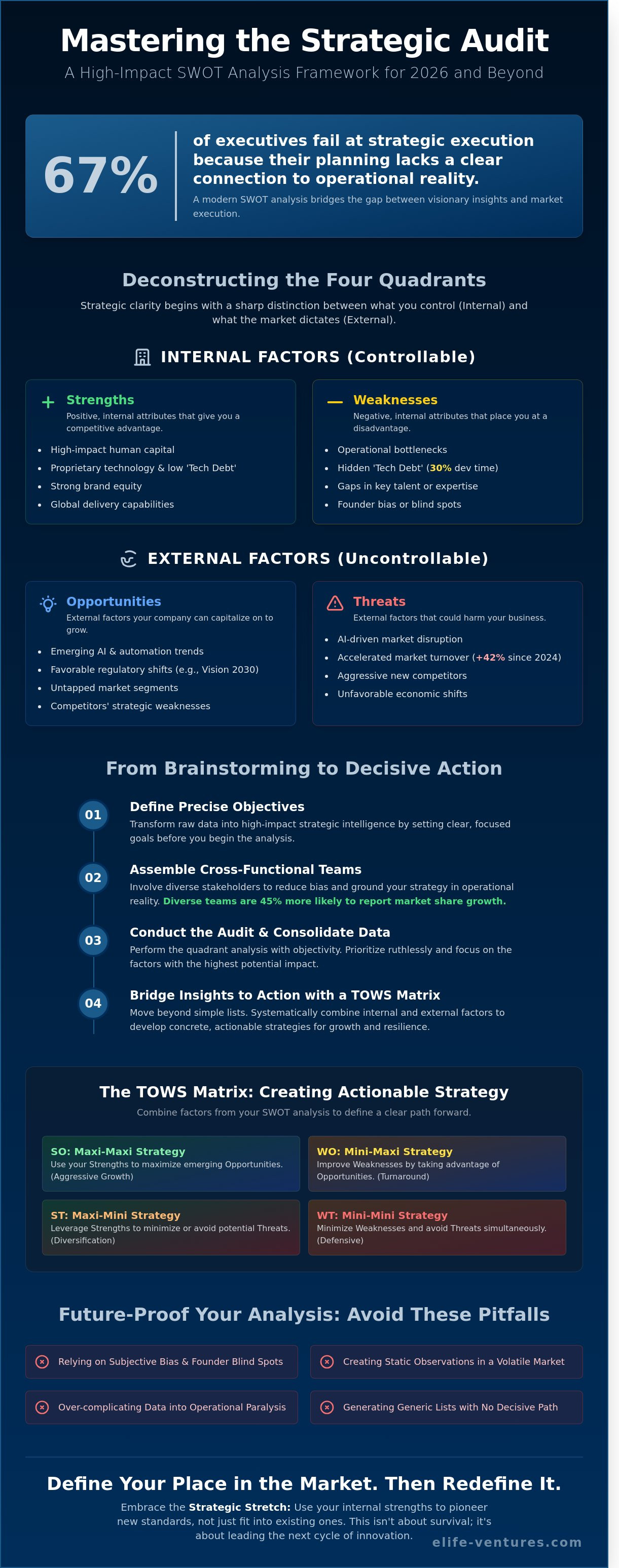
Strategic clarity begins with a sharp distinction between what we control and what the market dictates. Internal factors are the levers within your grasp. External factors are the forces acting upon your firm from the outside. Mastering how to do a SWOT analysis requires a clinical separation of these two realms. We define strengths and weaknesses as internal assets or liabilities. These are your proprietary advantages or your operational bottlenecks. Opportunities and threats represent environmental shifts. They're the market's invitation to grow or its warning to pivot.
Objectivity is the antidote to internal bias. Founders often overestimate their strengths and ignore their blind spots. To reduce this friction, we recommend a cross-functional audit. Involve stakeholders from engineering, sales, and customer success. A 2023 study found that diverse teams are 45% more likely to report market share growth. This collaborative approach ensures your assessment isn't just a reflection of the CEO's perspective; it's a grounded reality of the firm's standing. Understanding these dynamics is the core of knowing how to do a SWOT analysis that actually drives results.
Internal Factors: Auditing Your Core Competencies
Your internal audit should prioritize human capital and proprietary technology. We look for high-impact talent that can accelerate growth. Many firms overlook 'Tech Debt' during this phase. Recent data shows that 30% of developer time is often spent managing legacy code instead of building new features. This is a hidden weakness that can stall digital transformation. We also evaluate your brand equity and global delivery capabilities. These are the engines that empower your mission and define your competitive edge. If you're ready to scale these internal engines, partner with us to refine your roadmap.
External Factors: Navigating the Global Ecosystem
External analysis requires a visionary lens. We track emerging AI trends that could disrupt current business models. In the Middle East, regulatory shifts like the Saudi Vision 2030 or the UAE's AI Strategy create massive opportunities for agile firms. You must also monitor competitor movements and shifting demographics. Macroeconomic factors are equally vital. Funding cycles have tightened in 2024, raising the barrier for international market entry. Understanding these shifts allows us to build a resilient strategy that anticipates change. Success isn't just about having the best product; it's about being in the right place when the market shifts.
The Step-by-Step Execution: From Brainstorming to TOWS Matrix
Understanding how to do a swot analysis requires more than just filling in a 2x2 grid. It demands a rigorous, five-step execution process designed for impact. We start by defining a precise objective. A generic analysis leads to generic results. If your goal is to increase market share in the European fintech sector by 12% by Q4 2025, your SWOT must reflect that specific ambition. Clarity at the start prevents wasted energy later.
Execution begins with the human element. Assemble a cross-functional team of 6 to 8 people. Include voices from engineering, sales, and customer success. This diversity ensures a 360-degree view of the firm's reality. Data grounds these human perspectives. Conduct a data-driven audit using modern intelligence tools like Gartner or Forrester. Validating internal assumptions with external market data reduces bias. The University of Kansas SWOT Analysis Guide provides a robust framework for structuring this initial data collection phase to ensure no critical variable is overlooked.
Synthesis is the final bridge to action. We translate these findings into a TOWS Matrix. This isn't just a summary; it's a strategic map. Finally, we convert the matrix into a project-based AI implementation plan. Assign owners to every initiative. Set 90-day milestones. We don't just identify the future; we build the infrastructure to inhabit it.
Maximizing Brainstorming Efficiency
We prize precision over volume. Inclusive leadership means every voice carries weight without the need for shouting. We use parallel structures to categorize ideas quickly: define the challenge, identify the barrier, propose the solution. This rhythm keeps the session purposeful. Apply the "Top 10" rule to every list. If your team generates 50 points, discard 40. Focus exclusively on the 10 factors that will influence 80% of your revenue growth. Efficiency is our primary competitive advantage.
The TOWS Matrix: Creating Your Action Plan
The TOWS matrix converts static insights into strategic movement. It identifies how to leverage what you have to get where you're going.
- OS (Opportunity-Strength) Strategies: Deploy internal power to seize market gaps. If you maintain a 94% customer satisfaction rate, use that reputation to disrupt a competitor’s territory.
- TS (Threat-Strength) Strategies: Use existing assets to mitigate external risks. Leverage your $1.5M R&D budget to build a moat against emerging low-cost startups.
- OW and TW Strategies: These focus on transformation. We repair weaknesses through digital adoption. If manual workflows slow your output, implement AI automation to increase operational speed by 30%.
Common Pitfalls and How to Future-Proof Your Analysis
Confidence often masks blind spots. When founders ask how to do a swot analysis, they frequently start with the assumption that they already understand their internal hurdles. This is a dangerous trap. Confirmation bias leads teams to ignore data that contradicts their current worldview. You must approach this process with the intent to be proven wrong. We encourage our partners to invite external skeptics into the room to challenge every assertion and reveal hidden vulnerabilities.
Complexity kills momentum. Over-engineered matrices lead to operational paralysis. If your team spends 40 hours debating a single quadrant, you aren't strategizing; you're stalling. Keep your findings lean. Focus on the three most impactful factors in each category to maintain clarity. Precision is more valuable than volume when you're trying to disrupt a crowded market and accelerate your growth.
Bull markets create dangerous complacency. During the 2021 tech surge, 64% of high-growth startups neglected the 'Threats' quadrant, assuming capital would remain cheap. It didn't. Ignoring external risks during growth cycles leaves you vulnerable to sudden shifts. Use this checklist to validate your claims with empirical data:
- Link every 'Strength' to a verified KPI or P&L line item from the last fiscal year.
- Cross-reference 'Opportunities' with third-party market research published within the last 90 days.
- Assign a probability score and a specific financial impact in USD to every 'Threat'.
- Identify which team member is responsible for monitoring each quadrant weekly.
Avoiding the 'Static Document' Trap
A SWOT analysis is a living organism. We integrate these assessments into monthly consulting retainers to ensure strategy evolves alongside the market. Dynamic monitoring allows firms to deliver solutions internationally without losing local relevance. We believe strategic pivots are signs of visionary agility, not failure. Creating a culture that rewards these shifts ensures your firm remains resilient and ready to pioneer new categories.
2026 Trends in Strategic Auditing
By 2026, AI-driven platforms will automate real-time competitor tracking and SWOT generation. We're moving from qualitative guesses toward quantitative market intelligence metrics. These tools empower us to anticipate disruptions before they manifest in the balance sheet. This shift allows for more frequent iterations of how to do a swot analysis in a fast-paced ecosystem. Market Intelligence is the synthesis of data and human intuition. We use these insights to build long-term stability for our partners.
Turning Insights into Action: The E-Life Ventures Strategic Framework
Understanding how to do a swot analysis provides the clarity needed to see your firm's current reality. However, a 2023 Harvard Business Review study revealed that 67% of well-formulated strategies fail because of poor execution. E-Life Ventures FZA exists to close this gap. We act as your strategic ally, turning static insights into dynamic market advantages. We don't just identify opportunities; we build the technological engines to capture them.
Our approach integrates bespoke AI implementation and business automation directly into your strategic roadmap. If your analysis reveals an operational bottleneck, we deploy intelligent workflows to resolve it. This is how we deliver the Future of Work. We empower your human capital by automating the mundane, allowing your team to focus on high-impact innovation. We believe the intersection of human potential and digital precision is where true disruption happens. We help you move faster, think deeper, and scale further.
From Strategy to Implementation
Project-based fee structures ensure that 100% of our focus remains on your specific outcomes. We handle the entire lifecycle of your SWOT-driven objectives, from the initial technical audit to the final deployment. Our model eliminates the uncertainty of hourly billing, replacing it with a commitment to measurable growth. We provide ongoing advisory services because sustainable innovation requires constant refinement. We bridge industries by applying proven logic from the venture capital world to solve unique operational challenges. Our reliability is rooted in a track record of delivering 25% to 40% efficiency gains for our partners through strategic automation.
Your Next Step in Global Innovation
Transitioning from analysis to market leadership requires a partner who understands the high stakes of the global tech economy. We invite you to move beyond the whiteboard and start building. Pioneer your industry by leveraging our technical expertise and visionary mindset. Strategic trust is the foundation of every successful venture we lead. Our senior consultants are ready to conduct a tailored assessment of your firm's digital readiness. Connect with us to accelerate your transformation. Let's build the future together.
Charting Your Path to 2026
A 2026 strategic plan isn't a static document. It's a living blueprint for transformation. 2024 market reports indicate that volatility requires leaders to look beyond simple lists. They must embrace the TOWS matrix to bridge the gap between internal strengths and external threats. You've learned that mastering how to do a swot analysis requires more than just brainstorming. It demands a rigorous look at AI integration and the agility to pivot as conditions shift. We've seen that the top 10% of high-growth enterprises turn these raw insights into immediate, automated workflows.
Success in the $3 trillion digital economy depends on your ability to execute with precision. At eLife Ventures, we combine our authoritative expertise in Middle East market entry with a global reach rooted in the Ajman Free Zone. We're specialists in end-to-end AI implementation, helping founders move from vision to reality through enterprise advisory and business automation. The 2030 horizon belongs to those who prepare today.
Accelerate your digital transformation with a strategic consultation from eLife Ventures.
We're ready to build that future alongside you.
Frequently Asked Questions
What is the primary difference between a SWOT analysis and a TOWS matrix?
The primary difference is that a SWOT analysis identifies internal and external factors while a TOWS matrix matches them to create actionable strategies. Heinz Weihrich introduced the TOWS matrix in 1982 to bridge the gap between data collection and strategic execution. We use SWOT to categorize four distinct quadrants. We use TOWS to develop four specific strategy types; these include SO, ST, WO, and WT combinations. This transition transforms static data into a dynamic roadmap for growth.
How often should a tech-focused firm update its SWOT analysis?
Tech-focused firms should update their SWOT analysis every 90 days to align with rapid product cycles and market shifts. Markets move fast; waiting for an annual review risks 12 months of strategic drift. We recommend a refresh after every major version release or when a competitor secures a new round of funding. This cadence ensures your strategy stays as agile as your code. It keeps your team focused on real-time shifts in the global ecosystem.
Can a SWOT analysis be used for personal professional growth in 2026?
A SWOT analysis is a vital tool for personal professional growth in 2026 as AI replaces 40% of routine task hours. The World Economic Forum predicts that 50% of employees will need reskilling by 2025. Learning how to do a swot analysis on your own skillset helps you identify high-value human traits. You can map your unique empathy and creative problem-solving against emerging tech threats. It turns career uncertainty into a structured development plan.
Who should be involved in the strategic planning process to ensure a human-centric approach?
Strategic planning requires a cross-functional group of 5 to 10 individuals from every level of the firm. You must include frontline developers and customer success leads, not just the C-suite. A human-centric approach values the 70% of organizational knowledge that exists outside of executive offices. We facilitate these sessions to bridge the gap between data and lived experience. This diversity ensures your strategy reflects the people who build and use your products every day.
What are the most common mistakes when identifying external threats?
The most common mistake is identifying vague trends instead of three to five specific, quantifiable risks. Firms often list competition without naming the two specific startups eating their market share. Another error is ignoring regulatory shifts, such as the EU AI Act of 2024. Don't let your analysis stay at 30,000 feet. Use concrete data to define exactly how a threat impacts your 12-month revenue targets. Precision is the foundation of strategic trust.
How does AI integration change the way we conduct market intelligence?
AI integration shifts market intelligence from reactive reporting to real-time predictive modeling. Modern tools now process 10,000 data points in seconds to identify emerging competitor patterns. Gartner 2024 reports suggest that AI-driven insights reduce strategic planning time by 60%. This shift allows us to focus on high-level decision-making rather than manual data entry. We use these tools to empower human intuition with machine precision. It accelerates our ability to disrupt stagnant markets.
Is a SWOT analysis effective for international market entry strategies?
SWOT analysis is highly effective for international entry when you apply it to specific geographic regions. Over 80% of Fortune 500 firms use this framework to evaluate new territories. It helps you weigh three key entry barriers against your firm's existing scale. Understanding how to do a swot analysis for a global context reveals if your strengths translate across borders. It prevents costly errors in markets with 20% different regulatory requirements or unique cultural nuances.
What happens if our internal weaknesses are too significant to overcome?
If internal weaknesses are too significant, you must pivot your business model or seek a strategic partnership. McKinsey data shows that 70% of successful turnarounds involve a radical shift in core capabilities within 18 months. You don't have to face every deficit alone. We often suggest acquiring a smaller firm to plug a specific 30% gap in technical expertise. Admitting a weakness is the first step toward a more resilient, collaborative future. We prioritize long-term impact over ego.