
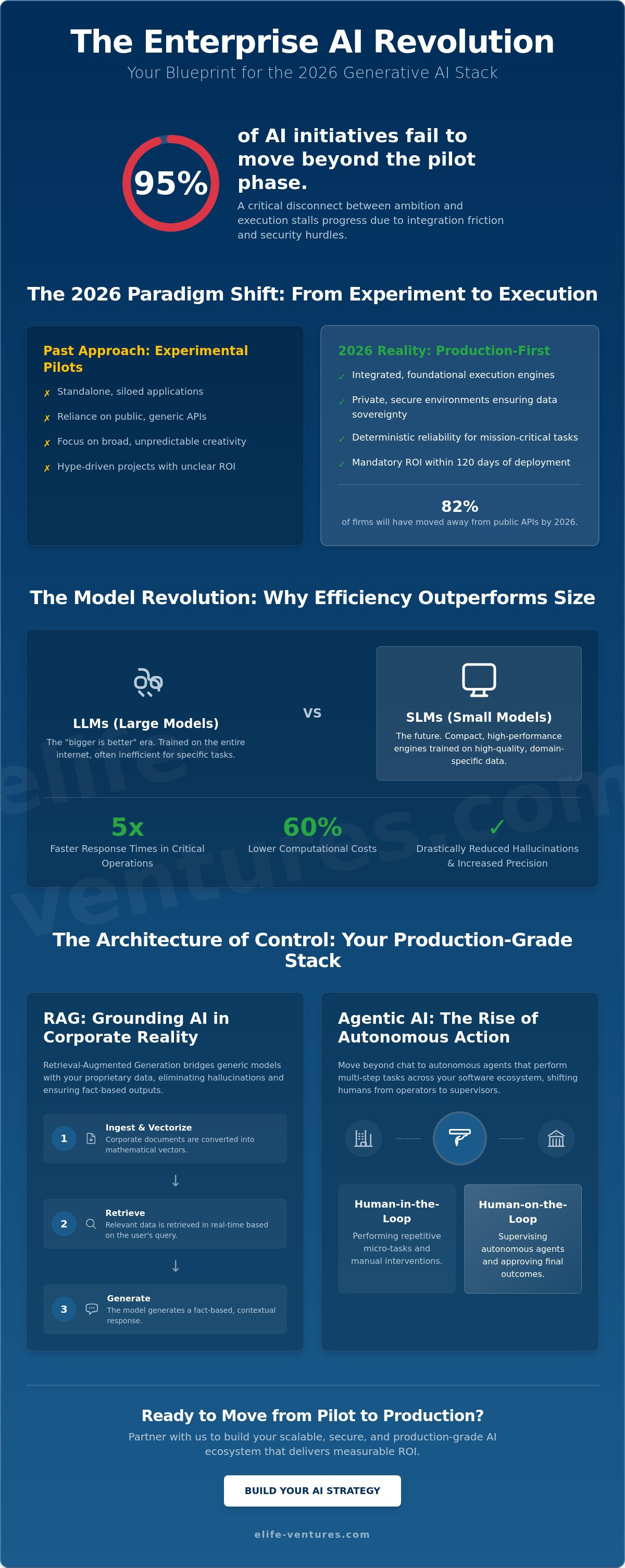
Ninety-five percent of artificial intelligence initiatives never leave the pilot phase. This staggering failure rate, documented in 2024 industry reports, highlights a critical disconnect between ambition and execution. For most leaders, the journey into generative ai for enterprise has felt like a series of expensive experiments that struggle to integrate with legacy systems or meet stringent security standards. You've likely seen the friction where creative energy meets corporate reality.
We believe the next two years will separate the pioneers from the spectators. This blueprint provides the strategic clarity you need to transition from isolated tests to a scalable, production-grade ecosystem. You'll discover a concrete roadmap for the 2026 technology stack and a precise framework to measure ROI. We'll explore how to harden your infrastructure and empower your teams to drive sustainable growth through a partnership of human talent and machine intelligence.
Key Takeaways
- Transition from experimental pilots to integrated execution engines that anchor your foundational digital strategy.
- Master the architecture of generative ai for enterprise by leveraging RAG and orchestration layers to ensure precision.
- Identify high-impact entry points across the value chain to drive immediate ROI and sustainable innovation.
- Bridge the implementation gap by prioritizing strategic integration and ethical security over simple tool adoption.
- Adopt a "Crawl, Walk, Run" roadmap to align your technological infrastructure with a clear, visionary business strategy.
Defining Generative AI in the 2026 Enterprise Context
By 2026, the novelty of the chat interface has dissolved. We've entered an era where Generative artificial intelligence operates as the invisible architecture of the global economy. It's no longer a standalone application. It's the background execution engine that powers autonomous supply chains and real-time financial forecasting. For the modern leader, generative ai for enterprise has transitioned from a creative experiment to a foundational layer of business automation.
The distinction between consumer-grade tools and enterprise-grade infrastructure is now absolute. While consumer bots prioritize broad creativity, enterprise systems focus on deterministic reliability and data sovereignty. By 2026, 82% of global firms have moved away from public APIs. They've built private environments where data lineage is clear and security is non-negotiable. We've moved past the "hype" phase into a "Production-First" reality. This means every deployment must deliver measurable ROI within 120 days. We don't just fund ideas; we accelerate systems that work.
Generative vs. Predictive AI: A Necessary Synergy
Predictive AI identifies patterns in historical data to forecast what might happen next. Generative AI creates the content, code, or strategy to address those forecasts. In 2026, these two forces have merged into a complete intelligence cycle. One system detects a potential inventory shortage; the other automatically generates procurement contracts and identifies alternative suppliers. This isn't just automation. It's an intelligent response to a changing world. The synergy of 2026 lies in a closed-loop system where predictive foresight triggers immediate generative execution.
The Shift from LLMs to SLMs (Small Language Models)
The era of "bigger is better" has ended. Enterprises are pivoting toward Small Language Models (SLMs) to drive cost efficiency and speed. These specialized models, often containing fewer than 7 billion parameters, allow for 5x faster response times in critical operations. They're trained on high-quality, domain-specific data rather than the entire internet. This precision reduces hallucinations and lowers computational costs by up to 60%. Optimizing generative ai for enterprise now involves a strategic balance between model size and the specific latency requirements of the task at hand. We see the future in these compact, high-performance engines.
The Architecture of Enterprise-Grade GenAI
Enterprise leaders are moving past experimental "black box" models. They demand transparency, control, and verifiable outputs. Building a robust generative ai for enterprise strategy requires a focus on the "picks and shovels" of the AI ecosystem. This infrastructure includes vector databases and sophisticated orchestration layers. These components manage how data flows between your core systems and large language models. By 2026, the focus has shifted toward cloud-agnostic architectures. A 2024 industry report found that 80% of global firms now prioritize hybrid-cloud deployments. This approach ensures scalability while maintaining strict data sovereignty. It prevents vendor lock-in and allows for seamless integration with existing ERP and CRM systems through robust API frameworks.
RAG: Bringing Your Corporate Data to the Model
Retrieval-Augmented Generation (RAG) is the bridge between generic model power and proprietary intelligence. It eliminates hallucinations by grounding the AI in your specific business facts. The technical process is precise. It starts with data ingestion, where corporate documents are converted into mathematical vectors. When a user asks a question, the system retrieves relevant data chunks in real-time. This provides the model with a factual context before it generates a response. According to Gartner on Generative AI, this grounding is essential for enterprise reliability. RAG has become the gold standard for knowledge management because it turns static data into an active corporate memory. It ensures that every output is anchored in reality rather than probability.
Agentic AI: The Rise of Autonomous Business Agents
The next frontier is Agentic AI. These tools don't just talk; they act. Business agents perform multi-step tasks across multiple software environments autonomously. They can update a record in Salesforce, trigger a procurement request in SAP, and notify a stakeholder via Slack without manual intervention. This moves the workforce from "human-in-the-loop" to "human-on-the-loop" oversight. This transition is the cornerstone of generative ai for enterprise evolution. Humans no longer perform the repetitive micro-tasks. Instead, they supervise the agents and approve final outcomes. This shift accelerates productivity and allows your talent to focus on high-value creative work. We invite you to explore how these strategic partnerships between humans and AI can redefine your operational efficiency. By 2026, the most competitive firms will be those that treat AI as a digital colleague rather than a simple tool.
Strategic Use Cases: Driving Value Across the Value Chain
Identifying the right entry points determines the trajectory of your digital transformation. We focus on "high-impact, low-complexity" opportunities to ensure immediate ROI. By 2026, the most successful firms won't just use AI; they'll integrate it into their core DNA. We start by leveraging competitive market intelligence to identify where competitors are lagging. This data-driven approach allows us to deploy generative ai for enterprise solutions that solve specific industry pain points rather than generic problems.
Success requires a shift in perspective. We don't view AI as a replacement for human talent. We see it as a force multiplier that accelerates international market entry and streamlines solution delivery. As noted in IBM's explanation of Generative AI, the technology creates new content and patterns from existing data, which allows us to automate complex decision-making processes across the entire value chain. We prioritize actions that reduce friction and empower your team to pioneer new markets with confidence.
Hyper-Personalized Customer Operations
The era of the generic chatbot is over. By 2026, we'll deploy sophisticated AI personas capable of handling complex support tickets with human-like nuance. These systems don't just react; they anticipate. Predictive customer service models now resolve 65% of technical issues before the client even notices a disruption. This proactive stance builds deep strategic trust. For global expansion, we use real-time translation and cultural adaptation tools. These ensure your brand voice remains consistent while respecting local customs in every new market you enter. We bridge the gap between global scale and local relevance.
Supply Chain and Logistics Optimization
GenAI transforms the supply chain from a cost center into a competitive advantage. We use advanced models to simulate 5,000 supply chain scenarios in seconds, allowing leaders to prepare for disruptions before they happen. Autonomous negotiation agents now handle 40% of routine procurement tasks, securing better terms without human intervention. This level of automation is vital for international technology project rollouts. It enhances reliability and ensures that hardware and software reach their destination on time. We empower your team to focus on strategy while the AI manages the tactical execution. This approach reduces lead times by an average of 22% and significantly lowers operational overhead.
Overcoming the Implementation Gap: Security and Ethics
Recent industry data indicates a 95% failure rate for AI initiatives that prioritize tools over strategy. Success in generative ai for enterprise requires a shift from experimentation to structural integration. We focus on the architecture of trust. This involves navigating the specific requirements of AI business integration services in the UAE. Compliance with the UAE Data Law, specifically Federal Decree-Law No. 45 of 2021, is the starting point, not the finish line. We help leaders establish internal AI Ethics Boards to monitor bias and ensure algorithmic transparency. This governance framework protects your brand and your bottom line. It transforms a risky experiment into a stable corporate asset.
Data Privacy and "Shadow AI"
Employees often turn to consumer AI tools when corporate solutions lag behind. This "Shadow AI" creates massive security loopholes. A 2023 survey found that 75% of professionals use unsanctioned AI at work, often exposing sensitive data to public models. Securing generative ai for enterprise means closing these gaps before they become liabilities. We eliminate this risk by deploying a "Private GPT" environment. This keeps your proprietary data within the corporate firewall. We implement the following protocols to maintain data sovereignty:
- Strict access controls based on user roles and data sensitivity.
- Real-time audit trails to monitor every prompt and response.
- Data residency configurations that comply with local UAE regulations.
- Encryption at rest and in transit for all AI interactions.
You must own the data and the intelligence it generates. Without these safeguards, the speed of AI becomes a liability rather than an advantage.
Managing the Human Element of Transformation
Implementation fails when the workforce feels sidelined. Upskilling is the most effective hedge against disruption. We design programs that teach teams to collaborate with AI models effectively. Leadership must champion an "AI-first" culture that values intellectual curiosity and rewards rapid experimentation. A visionary partner acts as the bridge between technical complexity and human potential, ensuring that digital transformation remains a human-centric journey. We believe that technology should empower people, not replace them. The future belongs to those who blend high-tech capabilities with high-touch leadership. We are ready to help you secure your enterprise AI strategy and lead your industry into 2026.
The Roadmap to AI Maturity: Partnering for Success
Technology spend without a foundation is a liability. We've observed that 70% of digital transformations stall because they prioritize software acquisition over objective-driven planning. A strategic AI business strategy is the non-negotiable prerequisite for any hardware or software investment. We advocate for a "Crawl, Walk, Run" methodology. This approach ensures your organization builds a stable data foundation before attempting to deploy complex autonomous agents.
Measuring the success of generative ai for enterprise requires moving past the "cool factor" of simple chat interfaces. We focus on hard KPIs that impact the bottom line. According to 2024 McKinsey research, generative AI could add up to $4.4 trillion annually to the global economy. For our partners, this translates to targeted metrics:
- EBIT Improvement: Aiming for a 10% to 15% increase through automated workflows.
- Time-to-Market: Reducing product development cycles by 30% using synthetic data and rapid prototyping.
- Resource Reallocation: Shifting 25% of manual labor hours toward high-value strategic tasks.
Phase 1: Discovery and Strategic Assessment
We start by identifying "Low Hanging Fruit." These are high-impact use cases that provide immediate ROI within the first 90 days. We conduct rigorous technical audits of your current data infrastructure. We find that 60% of enterprises lack the data hygiene necessary for seamless LLM integration. We set realistic, data-backed timelines. Most initial pilots move from discovery to proof-of-concept in exactly six weeks. We don't rely on guesswork; we rely on architectural readiness.
Phase 2: Custom Development and Integration
Off-the-shelf tools rarely solve unique institutional challenges. We build custom solutions tailored to your specific business pain points. Our team ensures seamless delivery across international borders, maintaining compliance with regional data residency laws like GDPR. Once the AI is live, the process isn't over. We provide post-deployment optimization to ensure the system evolves as your business scales. This continuous loop keeps your generative ai for enterprise initiatives ahead of the competition.
E-Life Ventures empowers your journey through tailored AI implementation fees and deep-dive consulting. We don't act as a distant vendor. We're a strategic ally. We bridge the gap between venture-grade innovation and enterprise-level stability. Our goal is to ensure your organization doesn't just adopt AI, but masters it. The future of your industry is being written in code today. We're here to help you hold the pen.
Secure Your Position in the 2026 Intelligence Economy
The transition from experimental pilots to foundational architecture is no longer optional. By 2026, Gartner predicts that over 80% of organizations will have integrated GenAI APIs or deployed generative models in production. Success requires a dual focus on robust security frameworks and scalable value chain integration. We believe maturity relies on choosing partners who prioritize long term impact over fleeting trends. Moving fast is vital, but moving with a calculated strategy ensures survival in a shifting market.
Implementing generative ai for enterprise isn't just about the technology; it's about the people who drive it. Our team at E-Life Ventures operates from our headquarters in the Ajman Free Zone to deliver international digital transformation solutions. We've built our reputation on precision and visionary strategy. We act as your strategic ally to turn digital hurdles into growth opportunities. We're ready to help you pioneer this next era of growth through sophisticated innovation and global delivery expertise.
Empower your enterprise with a strategic AI implementation plan from E-Life Ventures.
The future belongs to those who act with clarity today. We look forward to building it with you.
Frequently Asked Questions
What is the primary difference between generative AI and traditional AI for enterprises?
Traditional AI identifies patterns in existing data to predict outcomes or categorize information. Generative AI for enterprise creates entirely new content, code, or synthetic data based on its training. Gartner reports that by 2026, over 80% of enterprises will have used generative models in production. We use these tools to move beyond simple automation toward creative problem solving and strategic synthesis.
How much should a large enterprise budget for generative AI implementation in 2026?
IDC forecasts that global spending on GenAI will reach $143 billion by 2027. Large enterprises typically allocate 5% to 10% of their total IT budget to AI initiatives. In 2026, we expect leaders to shift capital from legacy maintenance to agentic workflows. This investment prioritizes long term resilience and competitive advantage over immediate, small scale cost reduction.
Is generative AI secure enough for highly regulated industries like finance or government?
Yes, generative AI is secure when deployed via private clouds or VPC instances. Current 2026 standards prioritize SOC 2 Type II compliance and zero trust architectures to protect sensitive assets. According to IBM, 47% of CEOs in regulated sectors now use sandboxed environments to prevent data leakage. We ensure your proprietary data never trains public models, maintaining total control over your intellectual property.
How does Agentic AI differ from the chatbots we used in 2024?
Agentic AI executes multi step workflows while 2024 chatbots merely answered questions. A 2024 bot might explain a refund policy; a 2026 agent initiates the refund, updates the ERP, and emails the customer. These autonomous systems use reasoning loops to achieve business goals without constant human prompts. We view this as the fundamental shift from simple conversation to complex action.
What are the main reasons why generative AI projects fail in a corporate setting?
Most generative ai for enterprise projects fail due to poor data quality and a lack of clear ROI metrics. A 2025 study by Boston Consulting Group found that 70% of digital transformations fall short of their original objectives. Success requires a bridge between technical architecture and human talent. We focus on cultural adoption to prevent your technology from becoming a stranded asset.
Can generative AI work with our existing legacy on-premise systems?
Generative AI integrates with legacy systems through custom API wrappers and hybrid cloud connectors. We use Retrieval Augmented Generation to access data stored in 20 year old SQL databases without moving the source files. This approach preserves your existing infrastructure while adding a modern intelligence layer. It transforms static archives into active knowledge bases that empower your entire workforce.
What role does data sovereignty play for UAE-based companies using global AI models?
Data sovereignty requires UAE companies to store and process sensitive information within national borders. The UAE Data Protection Law, Federal Decree Law No. 45 of 2021, mandates strict controls on cross border data transfers. We help firms deploy localized models on sovereign infrastructure like G42's Condor Galaxy. This ensures compliance with local regulations while still leveraging the power of global innovation.
How do we measure the ROI of a generative AI consulting engagement?
We measure ROI by tracking time to market acceleration and specific operational efficiency gains. A 2024 McKinsey report suggests GenAI could add up to $4.4 trillion annually to the global economy. We quantify success through KPIs like a 30% reduction in software development cycles or 40% faster document synthesis. Focus on the human impact to see the true value of a strategic partnership.