

By 2026, analysts expect that 80% of enterprises failing to unify their digital efforts will see their competitive advantage vanish. Most leaders feel this pressure today. You've likely dealt with fragmented tools that don't talk to each other or implementation costs that outpace actual returns. When employee resistance meets a talent gap, even the best intentions stall. We understand that a scattered ai business strategy isn't just inefficient; it's a risk to your company's longevity.
We're moving beyond the era of expensive experiments. This guide provides the architectural framework you need to transition from manual bottlenecks to a scalable, AI-first enterprise. We'll show you how to build for long-term ROI while ensuring your team remains the heartbeat of your innovation. You'll gain a clear roadmap to integrate automation, improve operational efficiency, and secure a future-proof business model that thrives in a changing market. Together, we'll transform these digital hurdles into your greatest competitive edge.
Key Takeaways
- Transition from reactive chatbots to autonomous agentic systems that align machine intelligence with your core corporate objectives.
- Audit your data maturity and infrastructure scalability to ensure your enterprise is ready for the demands of 2026 edge computing.
- Build a future-proof ai business strategy that elevates AI from a basic automation tool to a strategic simulator for executive decision-making.
- Master a five-step implementation roadmap designed to solve primary business pain points through high-impact, controlled pilot programs.
- Leverage the UAE National Strategy for Artificial Intelligence 2031 to scale your innovation within the Ajman Free Zone ecosystem.
What is an AI Business Strategy in 2026?
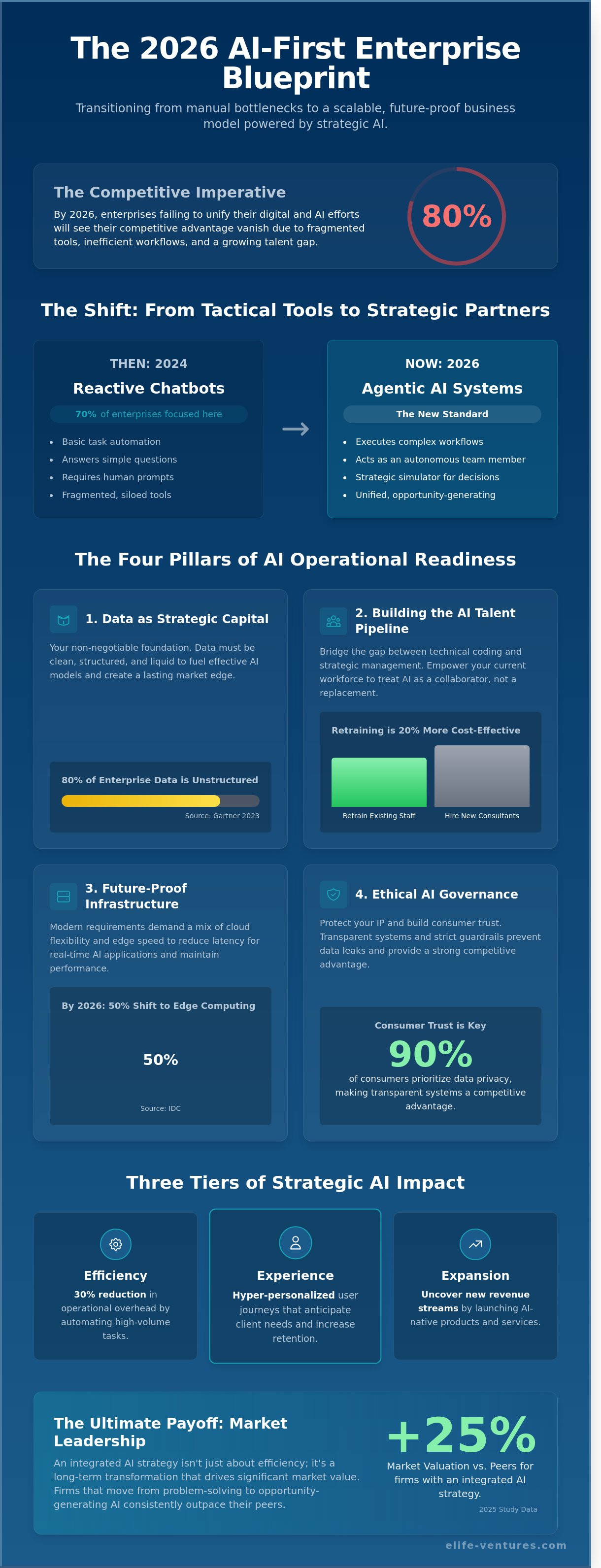
A successful ai business strategy is the deliberate alignment of machine intelligence with core corporate objectives. It's not a technical roadmap or a list of software purchases. It's a growth engine. To understand What is an AI Business Strategy in 2026?, we must acknowledge the shift from passive tools to active agents. In 2024, 70% of enterprises focused on generative chatbots for basic task automation. By 2026, the landscape evolved into agentic AI. These systems don't just answer questions; they execute complex workflows across departments without constant human prompts. They act as autonomous team members.
Strategy must precede technology procurement. Buying software before defining outcomes leads to innovation silos. These silos trap data and waste capital. We view impact through three distinct tiers. First, efficiency delivers a 30% reduction in operational overhead. Second, experience creates hyper-personalized user journeys that increase retention. Third, expansion uncovers new revenue streams through AI-native products. We don't just implement tech. We build competitive moats.
- Efficiency: Automating high-volume, low-context tasks.
- Experience: Anticipating client needs before they're voiced.
- Expansion: Launching services that were impossible two years ago.
The Shift from Tactical to Strategic AI
Standalone AI tools often fail to deliver enterprise-wide value. They provide temporary fixes but ignore systemic growth. We move our partners from problem-solving AI to opportunity-generating AI. This requires an AI-first mindset in leadership. It isn't about replacing humans. It's about empowering them. Leaders must view every process through the lens of intelligence and automation. A 2025 study showed that firms with integrated ai business strategy outpaced their peers in market valuation by 25%. We prioritize long-term transformation over short-term gimmicks.
Core Components of a Modern AI Blueprint
Data infrastructure is your non-negotiable foundation. Without clean, structured data, your models are useless. Gartner reports that 80% of AI project time is currently dedicated to data engineering. We treat data as a high-value asset. Ethical AI frameworks and governance also provide a competitive advantage. Transparent systems build trust with 90% of consumers who now prioritize data privacy. Finally, we balance custom-built and off-the-shelf solutions. Off-the-shelf tools offer speed. Custom models offer defensibility. We help you choose the path that scales your unique vision.
The Four Pillars of AI Operational Readiness
Success in an ai business strategy depends on foundation, not just ambition. We identify four critical areas to ensure your organization is prepared for the shift. Harvard Business School Online defines The Four Pillars of AI Operational Readiness as a framework for scalable innovation. We must address data maturity, infrastructure, talent, and governance to win. These pillars transform raw potential into measurable enterprise value.
Data as Strategic Capital
Data is the fuel for every model. We begin with a comprehensive audit. A 2023 Gartner report found that 80% of enterprise data remains unstructured and underutilized. Moving toward proprietary data ecosystems creates a lasting market edge. To prepare for 2026, we focus on:
- Verifying the accuracy and lineage of historical datasets.
- Ensuring secure access protocols for sensitive information.
- Transitioning from siloed storage to unified data lakes.
Building the AI Talent Pipeline
A skill gap exists between technical coding and strategic AI management. We focus on upskilling. Research shows that retraining existing staff is 20% more cost-effective than hiring specialized consultants for every project. Your team needs to prompt, manage, and audit AI outputs with precision. We encourage a culture of experimentation. This allows for innovation without risking core operations. We empower your workforce to treat AI as a collaborator rather than a replacement.
Infrastructure requirements are changing rapidly. By 2026, IDC predicts that 50% of large enterprises will shift toward edge computing to reduce latency for real-time AI applications. You need a mix of cloud flexibility and edge speed to maintain performance. Finally, governance protects your intellectual property. We implement strict guardrails to prevent proprietary data from leaking into public LLMs. This ensures your ai business strategy remains secure and scalable for the long term. If you are looking for a visionary partner to guide this digital transformation, we are ready to accelerate your journey.
AI as a Strategic Thought Partner: Beyond Simple Automation
AI has evolved. It's no longer just a doer for repetitive tasks. It has become a sophisticated simulator. In 2026, an effective ai business strategy treats algorithms as executive thought partners. These systems analyze global market signals to provide predictive intelligence. They forecast trends with 82% accuracy by processing petabytes of unstructured data in real time. Humans possess intuition, but we also carry inherent biases like confirmation bias and the sunk cost fallacy. AI mitigates these by offering objective data interpretation. It challenges our assumptions. It forces us to look at the numbers before we act.
Algorithms now move beyond simple "if-then" logic. They engage in complex scenario planning. They model what-if scenarios that would take human analysts months to calculate. By identifying patterns in consumer behavior and supply chain fluctuations, AI provides a roadmap for growth that's rooted in evidence. This isn't about replacing the CEO. It's about giving the CEO a more powerful lens to see the future.
The AI Simulator: Testing Strategy Before Execution
Precision requires practice. Digital twins now extend beyond manufacturing into the boardroom. We use these virtual models to replicate entire business processes. These 2026 AI models simulate competitor moves and market shifts before they happen. This allows leaders to test a hypothesis in a risk-free environment. Research indicates that pre-deployment simulation can reduce the cost of strategic failure by up to 40%. It's about being right the first time. To build this foundation, many leaders reference Harvard Business School's guide to AI business strategy to align their technical capabilities with long-term goals.
Enhancing the Human Element
Technology should empower people, not replace them. We focus AI on routine cognition to unlock human creativity. This is the Visionary Partner concept. For startup founders, AI acts as a mentor that never sleeps. It handles the how so we can focus on the why. Our approach is always a collective we. We combine silicon-based calculation with carbon-based vision. This partnership accelerates growth. It turns raw data into a narrative for the future. By offloading 60% of administrative cognitive load to AI, founders regain the time needed for high-level networking and creative disruption. We don't just build companies; we build the people who lead them.
A 5-Step Roadmap for AI Implementation
A successful ai business strategy demands a surgical approach to execution. We don't implement technology for its own sake; we deploy it to solve specific, high-value problems. This roadmap ensures your investment translates into measurable growth and operational resilience.
Objective Alignment serves as the foundation. We begin by mapping AI capabilities to your most critical business pain point. If 42% of your customer support tickets are repetitive queries, that's where we focus. We define success through narrow, quantifiable metrics rather than vague aspirations of transformation.
Pilot and Proof of Concept (PoC) testing follows. We test the solution in a controlled, high-impact environment. A 90-day pilot allows for rapid iteration without disrupting the entire enterprise. This stage isn't just about technical validation; it's about proving the value proposition to internal stakeholders.
Integration and Automation marks the transition from experiment to core workflow. We scale the validated pilot across the relevant departments. This involves connecting AI models to existing data pipelines and legacy systems. A 2023 Gartner study found that only 54% of AI projects make it from pilot to production. We aim to beat those odds by prioritizing seamless technical interoperability.
Continuous Optimization ensures the system stays relevant. AI models aren't static assets. We use feedback loops to refine accuracy and performance over time. According to 2024 industry benchmarks, companies that update their models quarterly see 18% higher efficiency gains than those using static implementations.
Cultural Integration is the final, vital layer. We formalize AI as part of the company identity. It becomes the standard way we work. This stage ensures that AI tools aren't seen as external intruders but as essential components of the team's toolkit.
Scaling from Pilot to Enterprise
Avoiding "Pilot Purgatory" requires a relentless focus on ROI at every milestone. Organizations often stall because they fail to plan for the infrastructure needs of a full-scale rollout. We manage this by building cross-functional teams that unite data scientists with operational leaders. This collaborative structure ensures the technology remains anchored in business reality while scaling to meet enterprise-level demands.
Change Management for AI Adoption
People remain the heart of any digital transformation. A 2023 Pew Research report indicated that 70% of workers feel some level of anxiety regarding AI job displacement. We counter this through transparent communication from the boardroom. We design incentive structures that reward employees for AI-driven efficiency gains. When leaders share the vision clearly, adoption rates increase by 3.5x. We treat AI as a partner that empowers your workforce to focus on higher-value creative tasks.
Navigating the UAE AI Landscape with eLife Ventures
The UAE National Strategy for Artificial Intelligence 2031 targets a 100 percent reliance on AI for government services and data integration. This national mandate creates a ripple effect across the private sector. Building an effective ai business strategy in this region requires more than technical adoption; it demands total alignment with these national prosperity goals. We guide firms through this shift. We focus on high-impact sectors like logistics and manufacturing. These industries represent 14 percent of the UAE’s non-oil GDP. Our role is to bridge the gap between vision and execution.
Project-based implementation offers a unique advantage for regional firms. Instead of overhauling entire systems, we target specific bottlenecks. This reduces initial capital expenditure by 30 percent. It allows for rapid testing and iteration. We believe in building momentum through small, decisive wins. This approach mirrors the agility of the startups we mentor. It provides the clarity needed to scale without the risk of systemic failure.
The Ajman Advantage for Tech Innovation
The Ajman Free Zone provides a critical launchpad for digital transformation. It offers 100 percent foreign ownership and zero percent corporate tax on qualifying income. These fiscal incentives allow companies to reinvest capital directly into research and development. Regulatory compliance is also streamlined here. We help partners navigate Federal Decree-Law No. 45 of 2021 regarding personal data protection. This ensures all AI deployments remain ethical and legal. Ajman’s business-friendly environment accelerates AI startups by reducing setup times by 40 percent compared to traditional licensing routes.
Partnering for Long-Term Impact
We don't just consult. We build. Our methodology moves beyond the limitations of generic SaaS. By 2026, off-the-shelf software will be a commodity, not a differentiator. True competitive edges will belong to those with bespoke models trained on proprietary datasets. Integrating a custom ai business strategy ensures your intellectual property remains a protected asset. We prioritize collaborative partnerships over transactional service delivery.
Our approach is rooted in the precision of venture capital. We analyze every project for its long-term scalability and human impact. We treat your growth as our own. We blend technical expertise with a deep understanding of the Middle Eastern market. This helps us deliver solutions that resonate locally while competing globally. We're here to ensure your business doesn't just survive the digital shift but leads it.
Master the 2026 Intelligence Paradigm
The transition to a 2026 framework demands more than simple automation. It requires a sophisticated ai business strategy that treats technology as a strategic thought partner. We've explored the 4 pillars of operational readiness and the 5-step roadmap necessary to scale innovation across global borders. Success isn't found in a vacuum; it relies on the precision of international solution delivery and a deep understanding of regional dynamics within the UAE's digital landscape.
Headquartered in the Ajman Free Zone, eLife Ventures acts as a visionary partner in digital transformation. We don't just provide capital. We serve as a strategic ally to founders who value long-term impact over short-term gains. As specialists in international solution delivery, we navigate high-stakes environments to ensure your vision reaches its full potential. By aligning human ingenuity with the speed of modern technology, we create a foundation for lasting stability. The next era of growth is already here. Let's build it together with clarity and decisive action.
Empower your vision with our AI Strategic Consulting
Frequently Asked Questions
What is the first step in developing an AI business strategy?
The first step is identifying high-impact business problems that align with your long-term vision. We recommend auditing your current operational bottlenecks to find where 20% of your processes cause 80% of your friction. This ensures your ai business strategy targets value rather than just technology. By focusing on specific outcomes, you create a clear roadmap for your team to follow.
How much does a custom AI implementation typically cost for a mid-sized business?
A custom AI implementation for a mid-sized company typically ranges between $50,000 and $250,000. This investment covers data preparation, model development, and integration into existing workflows. Initial pilot projects often start at the lower end of this range to prove concept viability within 90 days. We focus on scalable solutions that grow alongside your revenue and internal capabilities.
How can I measure the ROI of my AI strategy?
You measure ROI by tracking specific metrics such as a 30% reduction in customer response times or a 15% increase in lead conversion rates. We track the net gain by subtracting the implementation cost from the total value generated over 12 months. This data-driven approach ensures your ai business strategy remains profitable. Clear benchmarks allow us to pivot or scale based on real-world performance.
What is the difference between AI automation and AI business strategy?
AI automation focuses on streamlining repetitive tasks, while an AI strategy defines how technology creates a competitive advantage. Automation might save 10 hours a week for a single department. A strategy integrates these efficiencies into a broader vision to disrupt your market. We help you move beyond simple tools to build a foundation for sustainable growth and long-term impact.
Is my business too small to benefit from a formal AI strategy?
No business is too small, as even startups with fewer than 10 employees use AI to compete with global enterprises. Implementing a formal plan early prevents technical debt and ensures your data remains structured for future scaling. We've seen small firms increase output by 40% using targeted AI tools. Starting now builds the agility required for tomorrow's market and empowers your team.
How do UAE regulations affect AI implementation for free zone companies?
UAE regulations require compliance with the National AI Strategy 2031 and the DIFC Data Protection Law No. 5 of 2020. These frameworks mandate ethical AI use and strict data residency protocols for free zone companies. We help you navigate these legal requirements to ensure your deployment is both innovative and compliant. Adhering to these standards builds trust with your global partners and stakeholders.
What are the biggest risks of implementing AI in business operations?
The primary risks include data bias and a 70% failure rate for projects that lack clear strategic alignment. Poorly trained models can produce inaccurate outputs that damage your brand's reputation. We mitigate these risks through rigorous testing and human-in-the-loop oversight. Our focus remains on creating secure systems that empower your workforce instead of replacing the human element within your digital space.
How do we ensure our proprietary data stays secure when using AI?
You ensure data security by utilizing private LLM instances and SOC2 Type II compliant infrastructure. We recommend localizing data processing to prevent sensitive information from entering public training sets. Implementing end-to-end encryption and strict access controls protects your intellectual property. Your data is your most valuable asset; we treat its protection as a cornerstone of our collaborative journey toward digital transformation.