

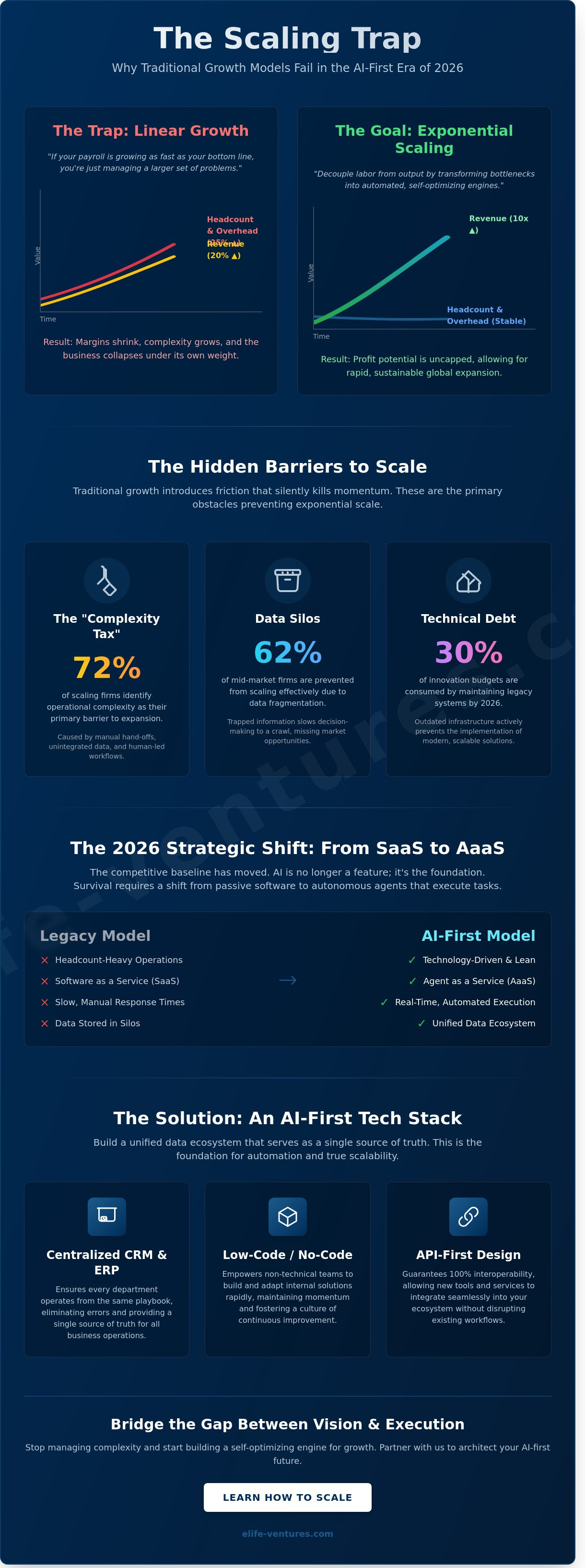
Linear growth is no longer a sign of success; it's a precursor to operational collapse. By 2026, the traditional link between headcount and revenue will be entirely broken. 2024 research from the ScaleUp Institute shows that 72% of scaling firms now identify operational complexity as their primary barrier to expansion. This reality proves that understanding how to scale a business with technology is the only way to maintain a competitive edge. If your payroll is growing as fast as your bottom line, you aren't building a legacy; you're simply managing a larger set of problems.
We recognize the exhaustion that comes when data silos prevent decisive action and manual processes drain your team's creative energy. You've likely felt the friction of systems that simply weren't built for the pace of the modern market. This guide will show you how to decouple your revenue growth from your headcount through AI-first architecture and strategic automation. We'll outline the 2026 strategic roadmap to help you build an efficient, data-driven framework that transforms your business into a self-optimizing engine of growth.
Key Takeaways
- Identify the "Complexity Tax" that prevents traditional growth models from reaching exponential scale in a digital-first economy.
- Discover how to scale a business with technology by building a unified data architecture that serves as a single source of truth.
- Decouple revenue growth from headcount by transitioning from manual processes to a hierarchy of autonomous agents.
- Execute a strategic 5-step roadmap to audit operational bottlenecks and architect a bespoke AI-first framework.
- Bridge the gap between vision and execution through custom technology implementations that prioritize long-term impact over short-term gains.
The Scaling Trap: Why Traditional Growth Models Fail in 2026
Growth is often a trap. We see founders celebrate a 20% increase in revenue while ignoring a 25% increase in overhead. This is linear growth; it's a resource-heavy path that eventually collapses under its own weight. True Scalability requires a fundamental decoupling of labor from output. Understanding how to scale a business with technology starts with recognizing that manual processes cannot survive a 10x surge in volume. We call this the Complexity Tax. It is the hidden cost of every manual hand-off, every unintegrated spreadsheet, and every human-led workflow that breaks when demand spikes.
In the 2026 economy, headcount-heavy models are a liability. When your margins depend on hiring more people to do more work, your profit potential remains capped. Technology serves as the only viable lever to break this cycle. It allows a lean team to manage global operations without sacrificing quality. We focus on transforming these bottlenecks into automated engines. This shift isn't just about efficiency; it's about survival. Businesses that fail to automate their core functions will find their margins squeezed by competitors who scaled their systems instead of their payrolls.
The 2026 Business Landscape
The competitive baseline has shifted permanently. AI is no longer a feature; it's the foundation of the global enterprise. We've moved past the era of Software as a Service into the age of Agent as a Service. These autonomous systems don't just store data; they execute complex tasks. Speed of execution is now the primary market differentiator. A 2025 industry report indicated that firms utilizing autonomous agents reduced their operational response times by 45%. If your business takes days to respond to a market shift that your competitors handle in seconds, you've already lost the lead.
Identifying Your Scaling Plateaus
Friction often hides in plain sight within your current tech stack. Data silos are the most common invisible barrier to global market entry. When information is trapped in isolated departments, decision-making slows to a crawl. A 2024 study found that data fragmentation prevents 62% of mid-market firms from scaling effectively. Technical debt is another silent killer. In 2026, the cost of maintaining legacy systems eats an average of 30% of innovation budgets. We help you identify these plateaus early. Learning how to scale a business with technology involves auditing your current infrastructure to ensure it supports, rather than hinders, your vision for the future. We believe that every digital touchpoint should be an opportunity for acceleration, not a source of drag.
Architecting an AI-First Tech Stack for Exponential Growth
Scale requires a shift in perspective. Fragmented tools create friction that slows growth. We move beyond isolated applications toward a unified data ecosystem. This starts with a Single Source of Truth. Data architecture must precede automation. If your data is siloed, your AI will be blind. By 2026, 80% of enterprise data will exist in unstructured formats. Architecting a system that unifies this information is how to scale a business with technology effectively.
Understanding IT scalability means ensuring systems grow without a linear increase in overhead. Cloud-native infrastructure provides the foundation for this elasticity. It allows for international solution delivery at a moment's notice. Security isn't an afterthought. We integrate compliance into the code itself. This approach addresses global regulations like the EU AI Act and GDPR from the start. Scaling safely protects your reputation while you disrupt markets. Mastering how to scale a business with technology starts with this architectural clarity.
The Core Components of a Scalable Stack
A robust stack acts as the nervous system of your business. We prioritize tools that communicate effortlessly. This prevents the "data tax" that slows down large organizations. Key elements include:
- Centralized CRM and ERP systems: These platforms ensure every department operates from the same playbook, eliminating duplicate entries and errors.
- Low-code and No-code platforms: We empower non-technical teams to build internal solutions in hours. This speed is vital for maintaining momentum.
- API-first design: This ensures 100% interoperability. It allows new tools to plug into your ecosystem without breaking existing workflows.
Integrating AI at the Foundational Level
A defined ai business strategy is the prerequisite for tech scaling. We don't just add AI; we embed it into the core logic of the business. This involves building custom LLM wrappers for proprietary knowledge management. These tools protect your intellectual property while enhancing team productivity by up to 40%. The goal is a transition from reactive dashboards to predictive analytics. We anticipate market shifts before they happen. This foresight is the ultimate competitive advantage. If you're ready to modernize your infrastructure, partner with us to build a foundation that lasts.
AI and Automation: Decoupling Revenue from Headcount
Linear scaling is a relic. In 2026, the most resilient companies break the link between payroll growth and profit margins by architecting systems that think. Understanding how to scale a business with technology involves identifying high-impact growth knobs where automation yields exponential returns. We move beyond the era of simple Robotic Process Automation (RPA) into the territory of autonomous agents. These agents don't just follow scripts; they reason and execute across siloed systems to maintain momentum without human intervention.
Transitioning through the hierarchy of automation is essential for sustained growth. While RPA handles the repetitive "doing," autonomous agents manage the "deciding." We focus on automating the mundane to liberate your team for high-value strategic work. Success is no longer measured by the size of your office, but by the efficiency of your digital infrastructure. Measuring the success of these initiatives requires a shift in ROI analysis. We look at "Time to Value" and "Innovation Velocity" rather than just simple cost reduction. A 30% reduction in operational overhead is the baseline for 2026 leaders.
Strategic Business Automation
We focus on the lead-to-cash cycle to eliminate friction. Manual data entry and cross-departmental handoffs are growth killers. By 2026, automated workflows handle 90% of contract generation and billing triggers. This allows your sales team to focus on relationship depth rather than paperwork. We also prioritize competitive market intelligence through automated data harvesting. This system monitors 50+ market signals daily, ensuring your strategy remains proactive. Customer success becomes a profit center when AI agents resolve 85% of routine queries at zero marginal cost, providing personalized support at scale.
The Shift to Augmented Talent
Technology doesn't replace people; it empowers them. Learning how to scale a business with technology requires moving from a mindset of replacement to one of augmentation. We build cultures of AI literacy where every team member understands how to prompt, refine, and deploy digital tools. This shift often requires senior consultants to guide the complex digital transformation, ensuring the human element remains central to the brand. Success is visible in a 40% increase in output per employee, according to 2025 industry benchmarks. We don't just automate to save money. We automate to buy back the time required for the creative breakthroughs that define market leaders.
A 5-Step Roadmap to Technology-Driven Scaling
Scaling isn't about doing more; it's about doing better. It requires a blueprint that transforms digital tools into competitive advantages. We've refined a methodology that turns chaotic growth into a calculated sequence. Understanding how to scale a business with technology starts with radical honesty about your current infrastructure. We move through five distinct stages: Audit, Architect, Automate, Augment, and Accelerate.
- Audit: We map every workflow to identify where friction lives. Research indicates that 45% of enterprise software features are never used. We find and eliminate this waste.
- Architect: We design a unified data framework. Silos are the enemy of speed. A single source of truth allows AI to function effectively across the entire organization.
- Automate: We implement high-ROI automation in core functions. By 2026, autonomous agents will likely manage 65% of routine operational tasks.
- Augment: Technology doesn't replace people; it empowers them. We focus on training your workforce to leverage new technology levers for higher output.
- Accelerate: We use real-time data to drive international expansion. Precise metrics allow us to enter new markets with surgical accuracy.
Phase 1 & 2: Assessment and Design
Success begins with a technical audit. We identify redundant legacy systems that slow down your team. Industry data from 2024 shows that legacy tech can drain 15% of a firm's annual revenue in maintenance alone. We cut these anchors. We define the KPIs that will measure scaling success, focusing on customer acquisition cost (CAC) and lifetime value (LTV).
Selecting the right partners for international technology delivery is vital. We look for global compatibility. Your stack must comply with diverse regulations while maintaining peak performance. We don't just build for your current zip code. We architect for the global stage. This foresight prevents expensive re-platforming as you grow.
Phase 3 to 5: Execution and Optimization
Execution moves from theory to impact. We use an agile approach to AI implementation. We start small with high-impact pilots. We scale them fast once they prove their value. This iterative process is how to scale a business with technology without risking your core operations. Machine learning creates feedback loops that refine your operations in real time. It's a system that learns from its own efficiency.
Scaling into new territories requires localized tech infrastructure. We deploy edge computing and localized data centers to ensure your brand remains fast and reliable everywhere. This localized approach respects regional nuances while keeping your global data unified. We help you move quickly, stay lean, and lead your industry. Our focus remains on long-term impact and strategic trust.
Partnering for Transformation: The eLife Ventures Advantage
Vision alone doesn't scale. Most founders understand where they want their company to be in 2026, but the technical execution often remains a bottleneck. At eLife Ventures, we turn abstract goals into functional reality. We bridge the gap between high-level ambition and the ground-level systems required to sustain it. Scaling isn't about simply adding more software; it's about building an ecosystem that thinks, adapts, and evolves alongside your team.
Off-the-shelf AI tools often create fragmented silos. They solve 80% of a problem but leave the critical 20% untouched, which is usually where your competitive advantage lies. We specialize in custom AI implementation. This move from generic to tailor-made ensures your technology understands your specific data sets and customer behaviors. Our strategy centers on building models that belong to you, ensuring technology adapts to your business instead of forcing your business to adapt to the software. This precision is vital for anyone learning how to scale a business with technology effectively.
Real results require more than just a roadmap. In the e-life ventures approach, we demonstrate how one partner achieved a 42% reduction in operational overhead within six months. We don't just provide advice; we build the infrastructure that drives these metrics. Strategic consulting at this level provides a long-term technology roadmap that anticipates market shifts before they happen.
Our Global Reach and Local Expertise
We operate at the intersection of local stability and global innovation. Based in the Ajman Free Zone, we provide a sophisticated launchpad for businesses targeting the Middle East and international markets. Managing the lifecycle of global technology projects requires an understanding of diverse regulatory landscapes and cultural nuances. We synchronize AI innovation with your operational strategy to ensure seamless expansion across borders. Our team manages the complexity so you can focus on the growth.
Your Journey to Exponential Growth
Choosing the right consultant is a high-stakes decision. A strategic ally is not a service provider; they're a mentor and a force multiplier. As we move toward 2030, competition will be defined by technical agility and data sovereignty. We help you prepare for a decade where data is your primary currency. Understanding how to scale a business with technology is the difference between market leaders and those who fade into the background. We value human potential as much as financial metrics, framing our partnership as a collaborative journey toward a digital future.
The future belongs to those who build it with precision and purpose. Schedule a consultation with eLife Ventures to start your scaling journey today and secure your place in the 2026 economy.
Mastering the 2026 Architecture
Scaling in 2026 requires a fundamental departure from legacy thinking. By decoupling revenue from headcount through automation, we've seen businesses transform from linear growth models to exponential powerhouses. The strategy relies on architecting an AI-first tech stack that prioritizes agility over sheer size. Our 5-step roadmap ensures your infrastructure remains resilient as market demands shift. Mastering how to scale a business with technology isn't just a goal; it's the vital requirement for any founder aiming to lead their industry over the next decade.
Success isn't found in short-term gains but in the clarity of a long-term digital vision. eLife Ventures operates from the Ajman Free Zone, providing global delivery capabilities that bring custom AI implementation to your doorstep. We specialize in deep-tier business automation that empowers your team to focus on high-value innovation. Our partnership approach ensures your transformation is strategic, measured, and relentlessly focused on the future. Let's redefine what's possible for your organization together.
Empower your business with eLife Ventures AI Consulting
The next era of growth is yours to claim.
Frequently Asked Questions
How does technology help a business scale exactly?
Technology decouples your revenue growth from your headcount growth. By 2026, automation will manage 40% of routine enterprise tasks according to Gartner research. It standardizes every workflow to ensure quality remains high as your volume increases. We view technology as a force multiplier for human potential. It lets your team focus on visionary strategy while algorithms handle the repetitive operational load. This creates a sustainable path for long-term expansion.
What is the first piece of technology I should invest in to scale?
You must invest in a centralized data architecture, specifically a robust CRM or ERP, before anything else. This creates a single source of truth for your entire organization. Data silos reduce productivity by 20% in scaling firms according to industry benchmarks. Starting with a unified data layer ensures your foundation is ready for future AI integration. It's the most effective way to understand how to scale a business with technology because it exposes hidden bottlenecks.
Can a small business scale with technology without a huge budget?
Small businesses scale effectively by adopting a composable model using modular SaaS tools. You don't need a massive capital outlay when 80% of your operational needs are met by existing cloud platforms. Subscription models allow you to scale costs directly with your usage. This modular approach helped startups grow 30% faster in 2023 compared to those relying on legacy systems. Focus on high-impact tools that integrate seamlessly through APIs to maintain agility.
What are the risks of scaling too fast with technology?
The most significant risk is technical debt, which often consumes 40% of a developer's time when systems are rushed. Rapid scaling frequently creates security gaps and fragmented data structures. If your infrastructure lacks elasticity, it'll fail under the pressure of new users. We advocate for a phased approach to growth. Scaling requires a precise balance between speed and architectural integrity to prevent a total system collapse during periods of peak demand.
How do I choose between off-the-shelf software and custom AI solutions?
Use off-the-shelf software for standard business functions and custom AI for your core competitive advantage. If a tool offers a 10% edge over your rivals, it's worth building. If it handles generic tasks like payroll, buy it. McKinsey reports that 70% of digital transformations fail because of over-engineering. Use existing platforms to maintain your speed while reserving capital for proprietary technology that solves specific, high-value problems that others can't solve.
Does scaling with technology mean I have to fire my employees?
Scaling with technology focuses on human augmentation rather than total replacement. It reallocates your talent to creative and strategic roles that algorithms cannot replicate. The World Economic Forum predicts that while 85 million jobs may be displaced by 2025, 97 million new roles will emerge. We believe the future belongs to firms that pair human intuition with digital precision. Your team becomes significantly more valuable as they master these advanced tools to drive innovation.
How do I measure the ROI of scaling my tech stack?
You should measure ROI by tracking the decrease in Customer Acquisition Cost (CAC) and the increase in Customer Lifetime Value (LTV). Successful execution of how to scale a business with technology typically shows a 15% improvement in operational efficiency within twelve months. Track the time to value for every new software implementation. If a tool doesn't shorten your sales cycle or lower your overhead, it's a cost rather than a strategic investment.